The Sign & Encrypt extension is designed as a cloud service. The following graphic provides a high-level perspective on the different modules of the service:
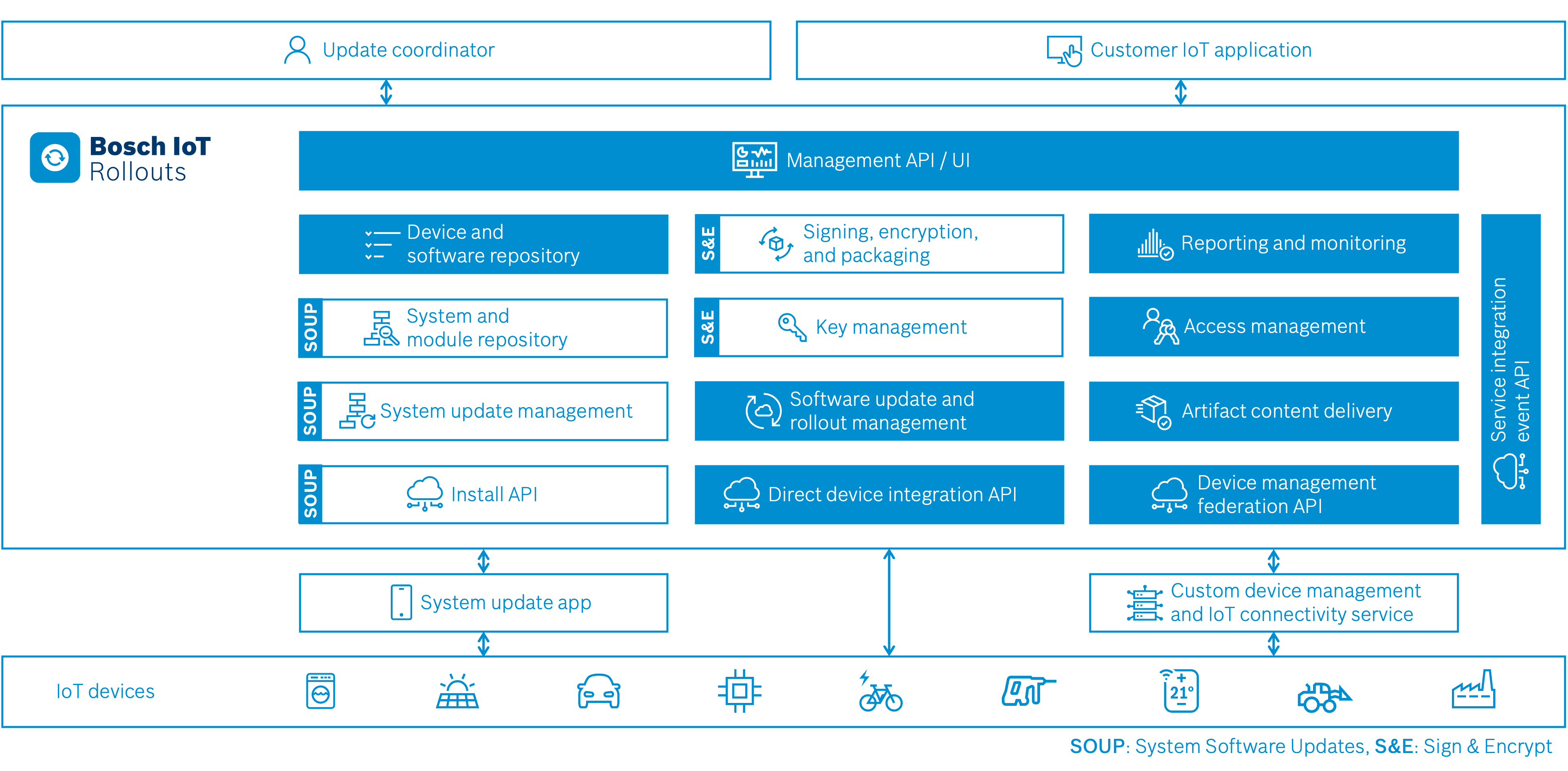
Key management
- Symmetric keys
- Asymmetric keys
- X.509 Certificates (managed by 3rd party)
Packaging
- Default packaging
- Project / customer specific container format can be added on demand
Encryption
- Ciphers
- AES256_CBC_PKCS7_PAD
- AES128_CBC_PKCS7_PAD
- AES256_CBC_ZERO_BYTE_PAD
- AES256_ECB_ZERO_BYTE_PAD
- AES128_ECB_ZERO_BYTE_PAD
- AES128_CTR_NO_PAD
- Others can be added on-demand
Signing
- Ciphers
- RSA_3072
- RSA_4096
- ECC_NIST_P256
- ED25519
- SHA256_PKCS_V15_2048 (only with 3rd party PKI)
- SHA256_PKCS_V15_3072 (only with 3rd party PKI)
- SHA256_ECDSA (only with 3rd party PKI)
- SHA256_PSS (only with 3rd party PKI)
- SHA512_PSS (only with 3rd party PKI)
- Others can be added on-demand
3rd Party Public Key Infrastructure (PKI)
- Escrypt.KMS X.509 PKI
- Others can be added on-demand
Interfaces
Authentication
- Bosch.IdM
- Bosch IoT Suite OAuth2 clients
Highlights
Optimal security
Public APIs are decoupled from the processes performing encryption and signing.
An entity-level security configuration (access control list) is used to limit users to a minimum set of rights.
Event-driven process
The Sign & Encrypt service is event-driven, enabling the decoupling of public and private resources already mentioned.
Events are also used to communicate the result of a task and to add its details to the audit log.
Audit logging
All tasks are automatically logged in the audit log, thanks to the event-driven mechanism.
The audit log can be viewed only by users who have sufficient permissions.
Four-eyes principle
Signing can be protected by an additional approval step that requires a second person to approve the task (four-eyes principle).
In addition, the approver may be required to authenticate with multi-factor authentication.
Container format
The applied container format is lightweight and easy to parse, which allows it to be implemented even on smaller embedded devices.
It is flexible in that it may contain multiple firmware images as payloads for devices with multiple controllers.
Furthermore, it supports an extendable list of well-selected cipher suites from which an adapting product may choose.
Key import and export
The system allows importing existing keys, thus easing migration to Sign & Encrypt.
If required, the keys can also be exported to avoid vendor lock-in.